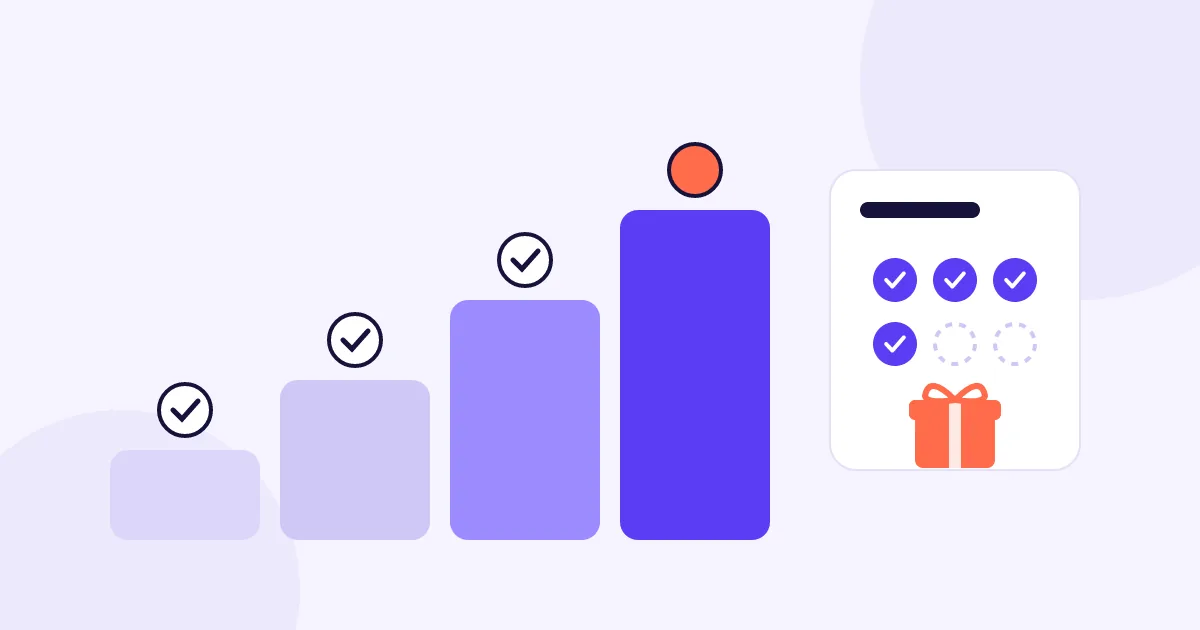
A loyalty program is a system that rewards customers for coming back to your business, usually with stamps per visit or points per dollar spent that they trade for a reward. The goal is to get customers to choose you more often and to give you a reason to stay in touch with them.
For a small business, the program doesn't need to be complicated. What matters is that customers understand in seconds what they get and how close they are, and that you can run it without slowing down the line.
The most common types are punch card (visit-based) programs, points programs, hybrids that combine both, tiered programs and paid memberships. For a small business, punch cards and points are the easiest to explain and run.
There are seven steps: set your goal, choose the program type, pick the reward, set the visit goal, write the rules, launch with your team and measure the results. You can knock them out in an afternoon if you have your average ticket and margin handy.
Write down in one sentence what you want to happen. For example: "get customers who come in once a month to come in twice." A concrete goal makes every other decision easier.
The reward should be something customers want that costs you little, like an item from your menu or a bonus service. Avoid discounts on the whole ticket.
A goal of 5 to 10 visits usually feels reachable. Give customers their first stamp when they sign up: starting with progress motivates people to finish the card.
Put the QR code where customers can see it, give your staff one line to invite every customer and ask for an email with a separate checkbox for receiving offers.
Each month, check how many customers signed up, how many came back and how many rewards were redeemed. Adjust the reward or the goal if nobody reaches the finish line.
Loyalty program design template
Reward, visit goal, earning and redemption rules, permission to contact and metrics, all on one page. Delivered to your inbox.
A reward should cost you less than the margin you make on a single visit and represent a small share of what the customer spent to earn it. That way, every reward you give away is backed by several visits that wouldn't have happened without the program.
Use this formula to check that your reward is sustainable:
For example, with a $12 average ticket and a 6-visit goal, a customer spends $72 before earning their reward. If the reward costs you $3.60, your reward rate is 5% of what they spent. If that feels high, raise the goal or pick a reward that costs you less but that customers still value.
Most loyalty programs fail because they're hard to understand, the goal is out of reach or the business never talks to its customers again. A program customers forget about is the same as having no program at all.
Avoid these mistakes:
Unappealing rewards. If the reward isn't exciting, nobody finishes the card.
Goals that are too long. Twenty visits for a free coffee will discourage anyone.
Confusing rules. If your staff can't explain it in one sentence, customers won't get it either.
Measure it by comparing how many customers come back, and how often, before and after launch. If visit frequency goes up and more customers return within 30 days, the program is doing its job.
Make it run on its own with a digital card that logs every visit and a system that alerts you, or acts for you, when a customer starts drifting away. That way the program doesn't depend on someone checking lists or remembering to send messages.
Relowme puts your stamp, points or hybrid program in Apple Wallet and Google Wallet, with no app for your customers to download. Your staff adds visits with a scan, and an AI agent spots customers who stop coming in, who are close to a reward or who have one they haven't used, then drafts campaigns with offers you've set. You approve them or turn on autopilot. To win customers back in the meantime, use these ready-to-use messages.
Somewhere between 5 and 10 visits is a reachable goal for most local businesses. Work out how much customers spend before earning the reward and make sure the reward cost is a small slice of that.
Punch cards work best when the ticket is similar every time and visits are frequent. Points work best when spend varies a lot between customers or purchases.
A paper card only costs the printing. A digital card costs a monthly subscription that covers visit tracking, reports and messaging. Either way, the main cost is the rewards you give away.
Put the QR code at the register and have your staff offer it at every checkout with a short line like "Want your first stamp on us?" Starting with progress boosts motivation.
Check your metrics once a month. If no one redeems rewards, lower the goal or improve the reward; if many customers stop coming in, turn on win-back messages.
About Relowme
Relowme is a loyalty program in Apple Wallet and Google Wallet for local businesses, with stamps, points or both, and an AI agent that spots inactive customers and wins them back automatically.